Preprint
MDCVRP MDCVRP
A Graph Matching Based Approach for the Multi-Depot Capacitated Vehicle Routing Problem
- Jayant Chandwani*
- Pranav M R*
- Anand Jat
- Anshu Ostwal
- Diptendu Chatterjee
- Anand Narasimhamurthy
- Department of CSIS, BITS Pilani K. K. Birla Goa Campus
* Lead authors, contributed equally

Abstract
The Multi-Depot Capacitated Vehicle Routing Problem (MDCVRP) asks for minimum-cost delivery tours from several capacitated depots to a set of customers. Like most vehicle-routing variants it is NP-hard, so practical solvers must trade solution quality against speed. This trade-off is sharpest in the dynamic settings that motivate this work, where routes must be revised as new orders arrive. We revisit it through the lens of graph matching. Adapting a matching-based construction first developed for the Traveling Tournament Problem, we present two algorithms, Cluster-First and Match-First, that reduce routing to a sequence of minimum-weight matchings. We prove that for tours of up to two targets the matching formulation solves the MDCVRP exactly in polynomial time for any number of depots. In the structured regimes, both algorithms are constant-factor approximations of this optimum, with a tight factor of two. This matching optimum coincides with the exact combinatorial-auction optimum, so the auction serves as a strong quality baseline. Because Cluster-First routes each depot independently, the approach also re-routes cheaply when new customers arrive. On instances of 1000 customers and 20 depots our methods match or beat the baseline in tour length while running two to three orders of magnitude faster, a scale at which exact and auction-based solvers become impractical.
The Problem
The MDCVRP combines capacitated vehicles with several geographically distributed depots. It is NP-hard, so exact methods are impractical beyond small instances and the literature is dominated by heuristics that trade optimality for speed. The usual recipe is cluster-first, route-next: group customers by depot, then route each cluster as a single-depot problem. Learning-based methods reach high quality on small instances but scale poorly and are expensive to train, which is a poor fit for the large, dynamically changing instances that arise in practice.
Input
Output
Why it is hard
Method
Rather than building routes sequentially, we reduce routing to minimum-weight matching on the complete graph whose vertices are the targets and whose edge weights are inter-target distances, computed with Edmonds' Blossom algorithm. Each matched pair becomes one tour that leaves a depot, visits both targets and returns; each unpaired target gets a singleton round trip. The construction adapts a matching-based bound originally proposed for the Traveling Tournament Problem.
Two algorithms
CF
Cluster-First
MF
Match-First
M&M
Match-and-Merge
Three scenarios
Scenario 1
Scenario 2
Scenario 3
As a strong point of comparison we also formulate the MDCVRP as a combinatorial auction, where depots bid on bundles of targets and a winner-determination step picks a feasible lowest-cost assignment. We evaluate two implementations of it, an Integer Linear Program (CA-ILP) and a Maximum Independent Set formulation (CA-MIS). In each scenario the auction is restricted to bundles no larger than the biggest tour the matching methods can form, so the comparison is like-for-like.
Theoretical Analysis
Tour size two is a tractability boundary
Tight 2-approximations
Running time
Larger tours
Results
All methods are implemented in C++ and run on randomly generated Euclidean instances: a base collection of 100 datasets with 100 targets and 10 depots, and a scalability collection of 50 datasets with 1000 targets and 20 depots. Every dataset fixes the number of depots and targets and varies only target locations and demands.
Quality at scale
2–4%
shorter tours than the CA-MIS auction on the 1000-target instances
Speed at scale
2–3 orders
of magnitude faster than the auction, which the ILP cannot solve at all
Choosing a baseline
A speed claim is only as convincing as the baseline it is measured against, so we first fix that baseline. Three standard solvers are compared on the base instances, all following the cluster-first, route-next pattern and differing only in how each single-depot subproblem is routed: a nearest-neighbour heuristic, a two-stage solver built on Google OR-Tools, and our combinatorial auction. The auction gives the shortest tours at both representative capacities.
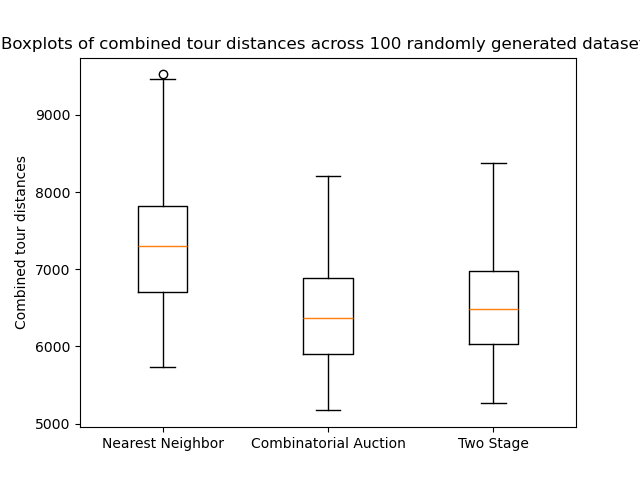
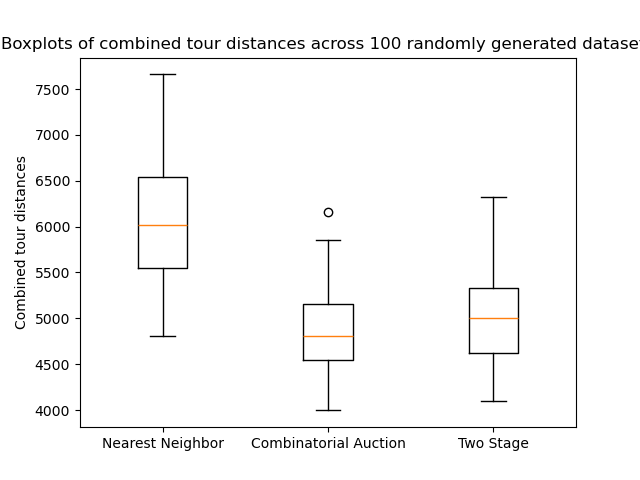
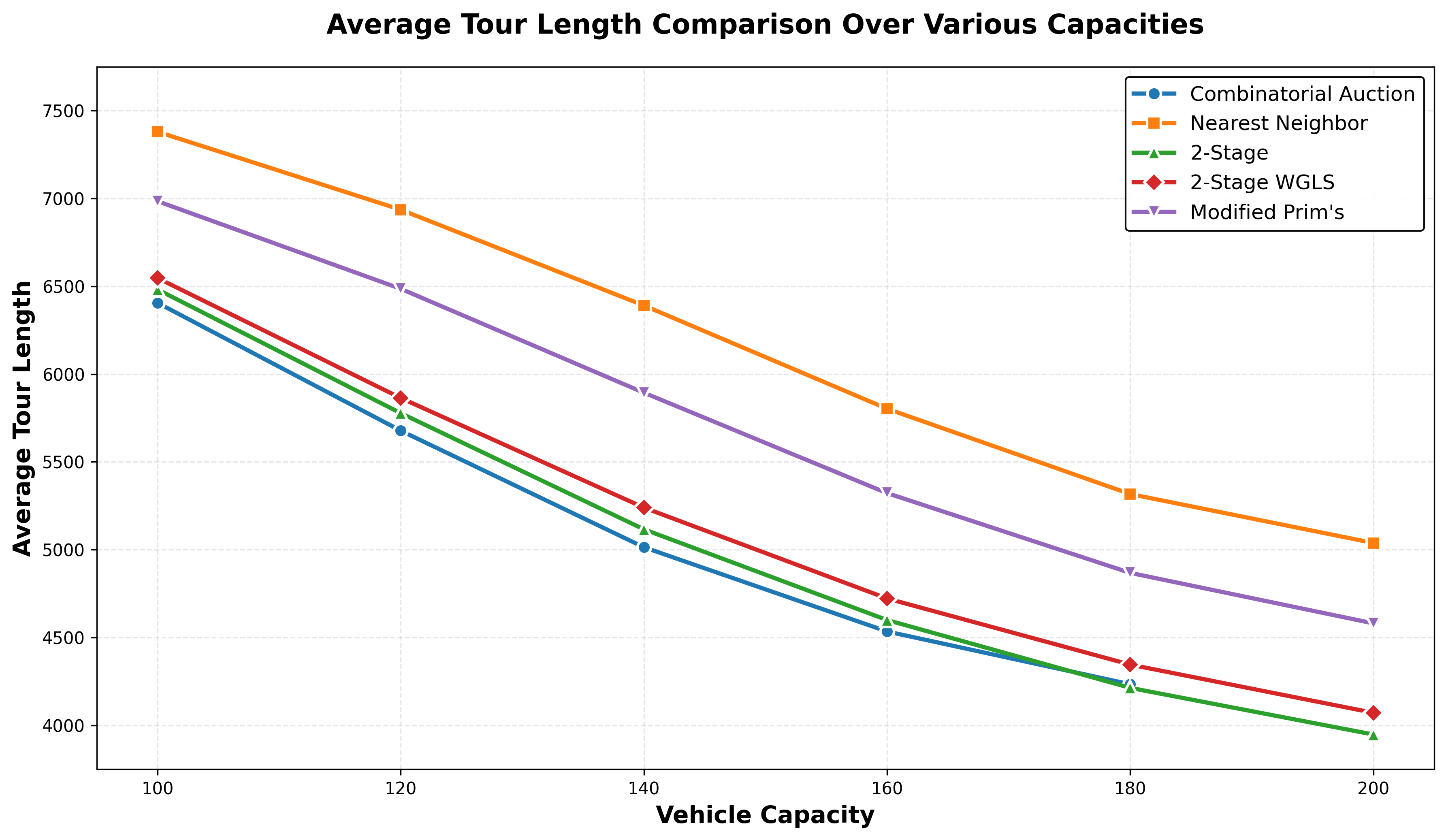
Sweeping the vehicle capacity confirms that the ranking is not an artefact of one setting. The auction leads across almost the whole range, and only in the regime where capacities dwarf target demands does a baseline draw level, which is expected given that we deliberately restrict the auction to small bundles. We therefore carry the auction forward as the single point of comparison.
RQ1: Graph matching versus the auction
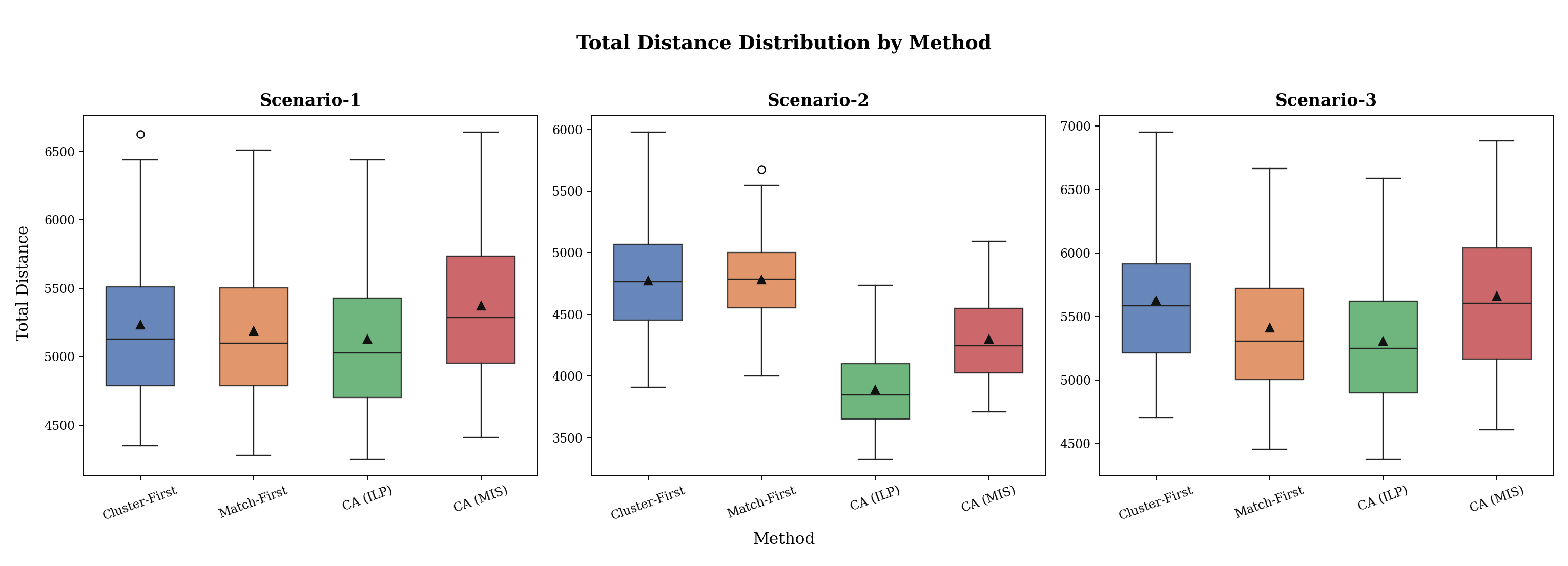
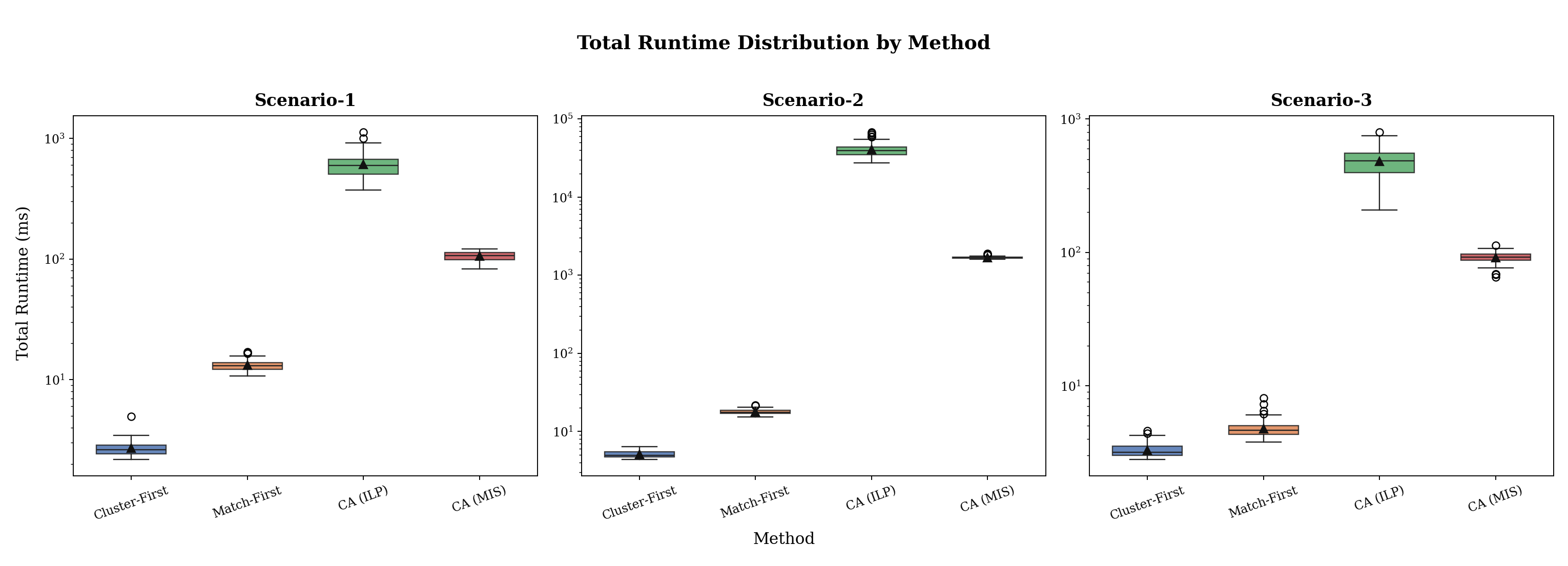
On the base instances the two matching methods are compared against both auction implementations across the three scenarios. The exact ILP auction attains the shortest tours, with the matching methods a few percent behind; against the MIS auction they are level or ahead in Scenarios 1 and 3. The runtime picture, on a log scale, is not close: in Scenario 3 the paper reports a mean tour of 5305 for CA-ILP at 479 ms per instance, against 5411 for Match-First at 4.8 ms and 5626 for Cluster-First at 3.3 ms, so the matching methods stay within 2 to 6% of the best tour at roughly two orders of magnitude less time.
RQ2: Effect of capacity
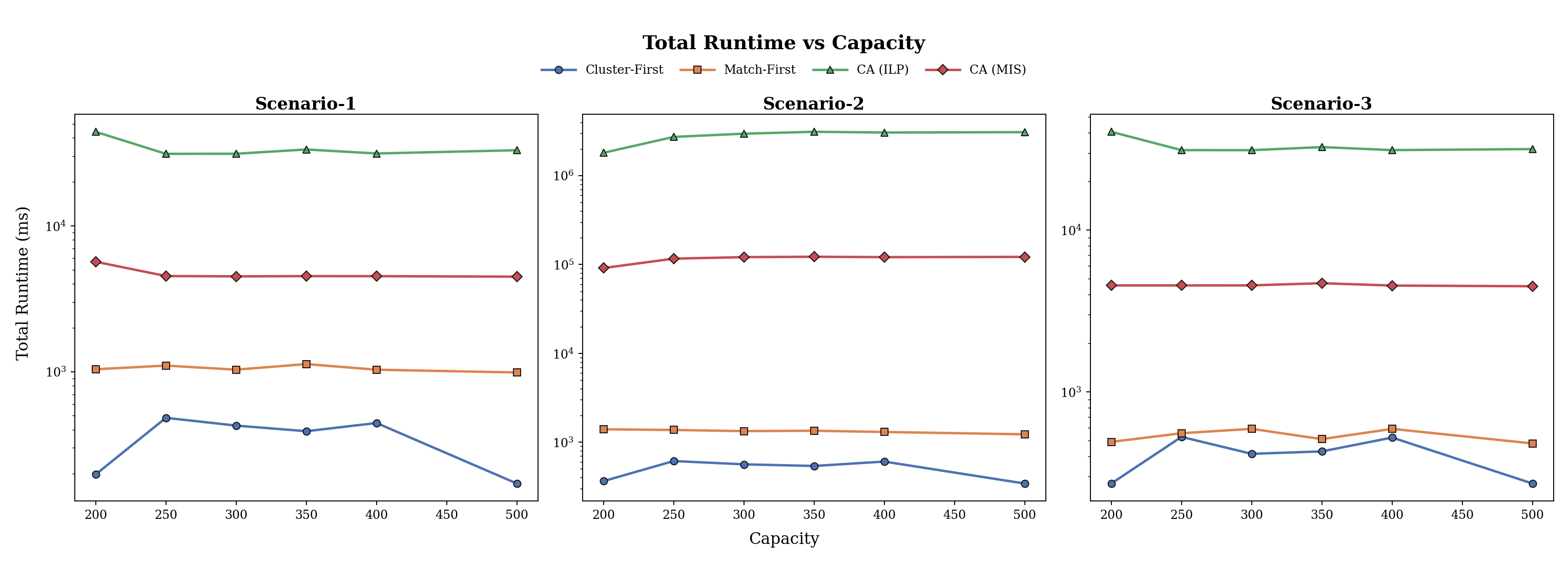
Varying the vehicle capacity leaves the ordering untouched. Both matching methods stay flat and far below both auction implementations at every capacity and in every scenario, so the speed advantage is a property of the method rather than of one operating point.
RQ3: Scalability
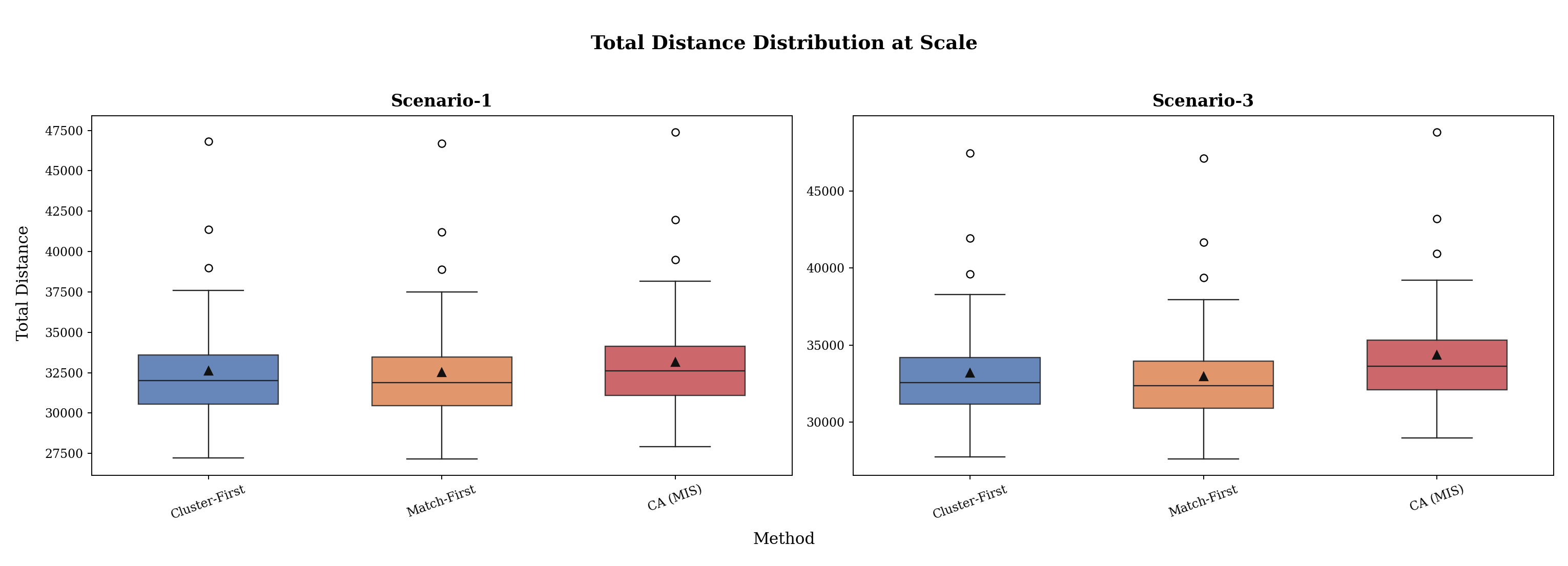
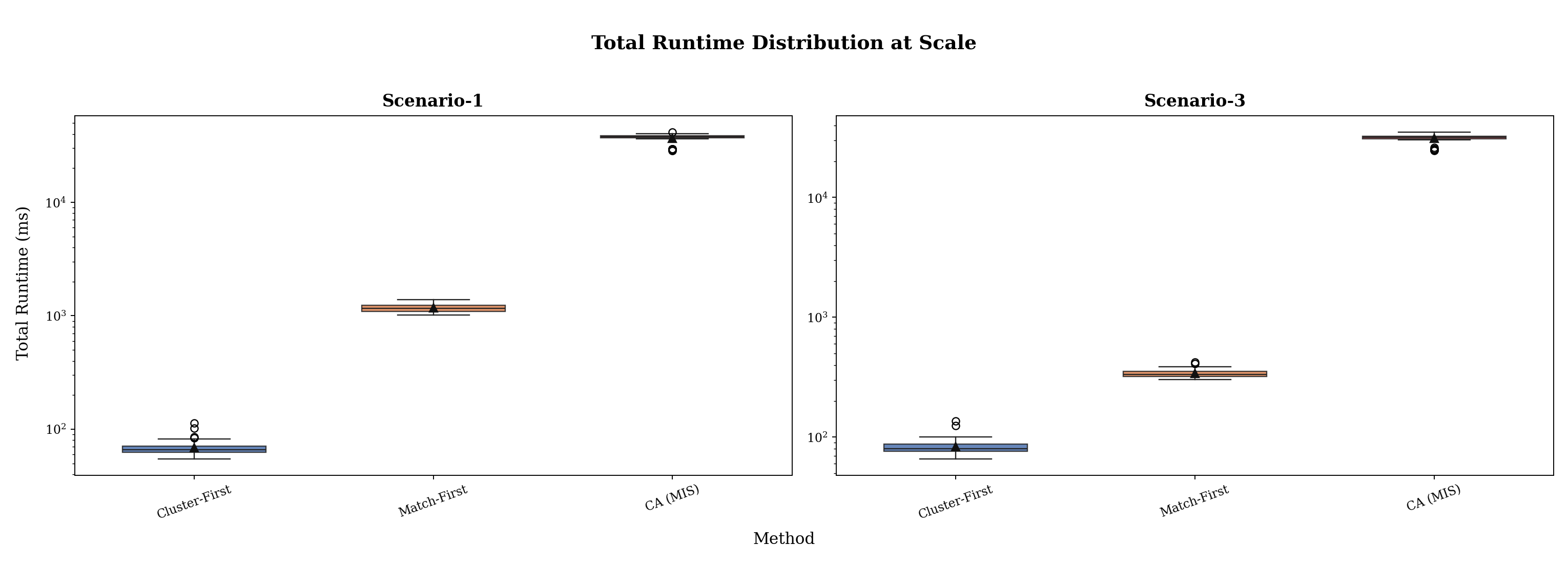
At 1000 targets and 20 depots the ILP auction no longer completes, and Scenario 2 is out of reach for the auction formulation entirely, since the number of candidate bundles explodes. Against CA-MIS the matching methods are no longer behind on quality: they match or slightly beat it in both scenarios shown. The time gap, meanwhile, widens to two or three orders of magnitude, with Cluster-First averaging tens of milliseconds per instance against tens of seconds for the auction.
The quality gap closes at scale
Orders of magnitude faster
Robust across capacities
Cheap to re-route
Citation
@misc{chandwani2026mdcvrp,
  title         = {A Graph Matching Based Approach for the Multi-Depot Capacitated Vehicle Routing Problem},
  author        = {Chandwani, Jayant and M R, Pranav and Jat, Anand and Ostwal, Anshu and Chatterjee, Diptendu and Narasimhamurthy, Anand},
  year          = {2026},
  eprint        = {2607.27727},
  archivePrefix = {arXiv},
  url           = {https://arxiv.org/abs/2607.27727}
}